One renter question. Five AI engines. Different answers.
The same apartment search produced different shortlists, different sources, and 3 distinct visibility outcomes.
Key takeaways
- Five AI engines answered the same renter question. On August 31 they named 26 distinct communities, and only 7 appeared in more than one answer.
- Only 1 of the 5 engines consistently credited community-owned websites.
- Named, credited, and recommended are 3 separate outcomes. A single visibility score would hide what happened.
We asked ChatGPT, Perplexity, Gemini, Copilot, and Google AI Mode the same question a renter might ask:
What are the best pet-friendly apartments in downtown Austin under $2,000?
We ran the question once in each engine on August 31, 2026, then repeated it on September 1.
All 10 answers named and recommended specific apartment communities. But they showed little agreement about which communities belonged on the list, and they rarely credited a community’s own website.
That is the gap worth watching.
The same question produced different shortlists
On August 31, the 5 engines named 26 distinct communities. Only 7 appeared in more than one answer.
On September 1, they named 19 communities. Only 3 appeared in more than one answer.
Even the community with the most overlap changed. On each date, 1 community appeared in 3 engines, but it was not the same community both times.
This was 1 run per engine per date, so we cannot say whether the change came from the day, normal run-to-run variation, or both. We can say that the same renter question did not produce 1 stable apartment ranking.
Here is what each engine returned. Community counts and owned-site credit are shown as August 31 / September 1.
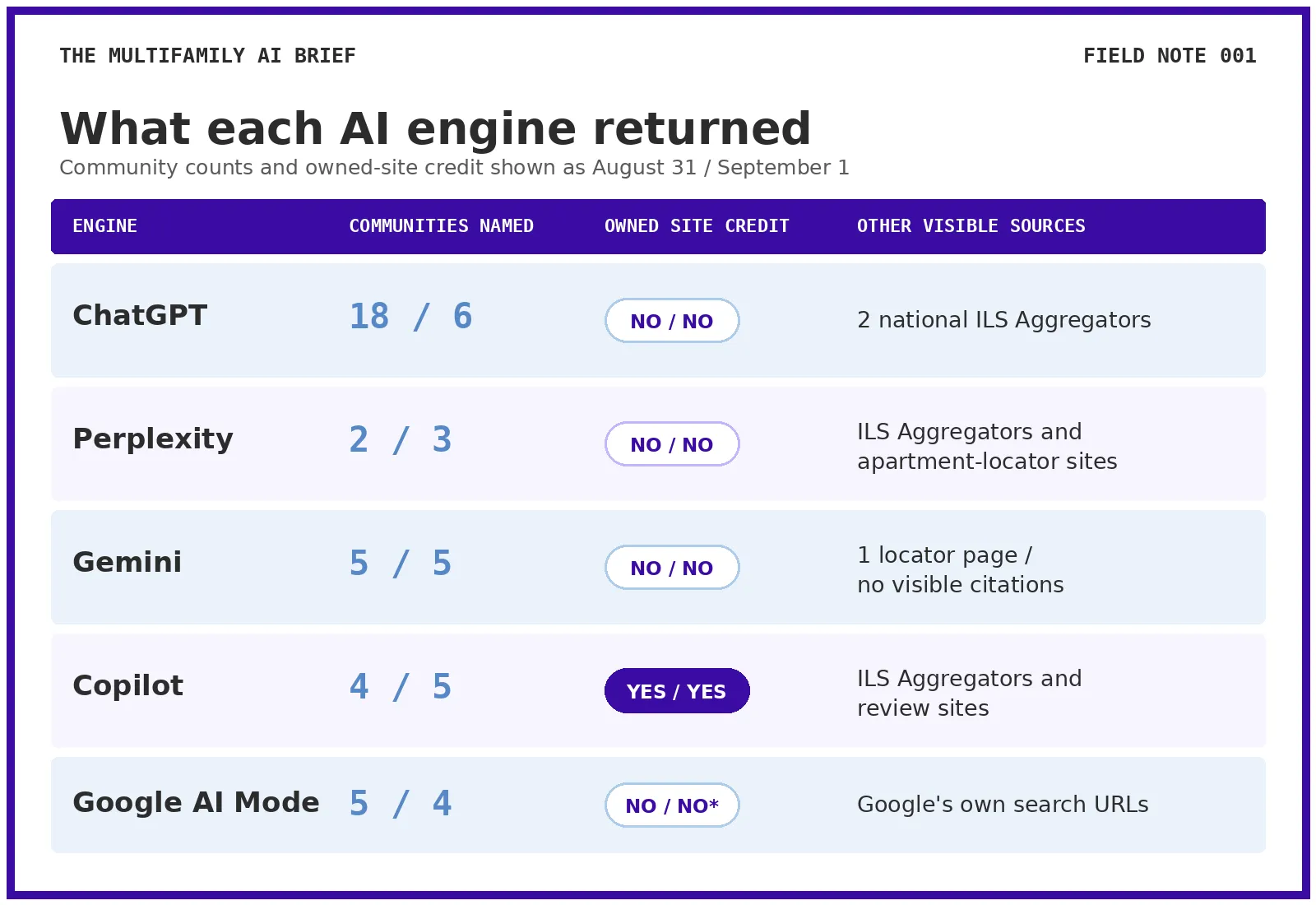
On September 1, Google AI Mode also surfaced community-owned links inside its place cards, even though those links did not appear in the main source list.
For a multifamily marketer, that makes “What is our AI ranking?” less useful than a few more specific questions:
- Are we being named?
- Are we being credited?
- Are we being recommended?
- Is the information accurate?
- Which competitors are appearing instead?
Being named is not the same as being credited
Across both dates, only 1 of the 5 engines consistently credited community-owned websites. The others primarily pointed to ILS aggregators, apartment locators, reviews, or their own search results.
One engine gave rent ranges and pet-policy information without any visible citations in 1 of its answers. Another surfaced community links inside place cards even though those links did not appear in its main source list. Citation interfaces differ, which is why the whole answer needs to be examined rather than only the sources displayed at the end.
The test supports 3 separate outcomes:
- Named: The community appears in the answer.
- Credited: The answer attributes information to the community’s own source.
- Recommended: The community is presented as a fit for the renter’s request.
A community can be named while an ILS aggregator receives the visible source credit. It can be recommended while another source is cited. It can also be absent while a competitor appears.
Collapsing those outcomes into 1 visibility score would hide what happened in this test.
The community is the unit that matters
Most AI visibility advice is written for big brands. Apartment searches work differently. Renters ask about a neighborhood, budget, pets, parking, amenities, commute, and availability. They do not necessarily begin with the operator or management-company name.
For a portfolio, AI visibility is therefore not 1 brand-level result. It is many communities, in many markets, competing across many renter-intent questions.
A simple first check
Before changing your website or chasing a new AI tactic, ask 2 or 3 AI engines 1 realistic question for your market.
For example:
What are the best pet-friendly apartments near [landmark] with in-unit laundry?
Record whether your community was named, credited, and recommended. Note which competitors appeared, which sources were used, and whether the price, pet policy, amenities, and location details were accurate.
Want to run the same check for your own community?
Make a copy of the free Multifamily AI Visibility Tracker to record when your community is named, which sources receive visible credit, and whether it is recommended as a fit across repeated tests.
Do not treat 1 check as a benchmark. Repeat it later without changing the wording. If you make an improvement to your website, listing, or Google Business Profile, change 1 thing at a time so the next observation has a chance of teaching you something.
The goal is not a magic optimization trick. It is understanding what renters may be told before they ever reach your website.
Method: We collected 1 logged-out run per engine per date using a scraper tool. The study used 1 query, 5 engines, 2 consecutive dates, and 1 market. Four runs were geo-targeted to Texas and Google AI Mode was geo-targeted to Austin. Logging out rules out account history, but not every form of location or personalization.
About these observations: Findings reflect what we recorded on the dates stated. AI answers, search results, and property information change frequently, and results vary by engine, location, and over time. These observations do not establish a universal disagreement or citation rate, evaluate any company’s performance, or endorse any product. Automated collection is closer to a controlled test than to a real renter’s experience. See our editorial standards and methodology.
The Multifamily AI Brief is research from keepfound, which is building a multifamily AI visibility platform to monitor renter-intent prompts, source attribution, competitor appearances, and the property information shaping AI answers.