Two properties. Similar AI visibility scores. Very different exposure.
Two properties had similar scores. Their engine-level exposure looked nothing alike.
Key takeaways
- Building A finished at 32.2% blended visibility and Building B at 28.5%, just 3.7 percentage points apart.
- Building B fell to 5.3% in Perplexity. Its highest engine was 8.3 times its lowest, compared with 1.3 times for Building A.
- A blended score is a useful summary, but also look at each engine, your lowest result, and the gap between your highest and lowest engine.
A property can look competitive in a blended AI visibility score while barely appearing in one engine.
We saw that after tracking an anonymized apartment market across ChatGPT, Perplexity, and Google AI Mode for 14 days.
Building A finished with 32.2% blended visibility. Building B finished at 28.5%.
Just 3.7 percentage points separated them. On a dashboard with one overall score, they would look like peers.
Then we opened the engine breakdown.
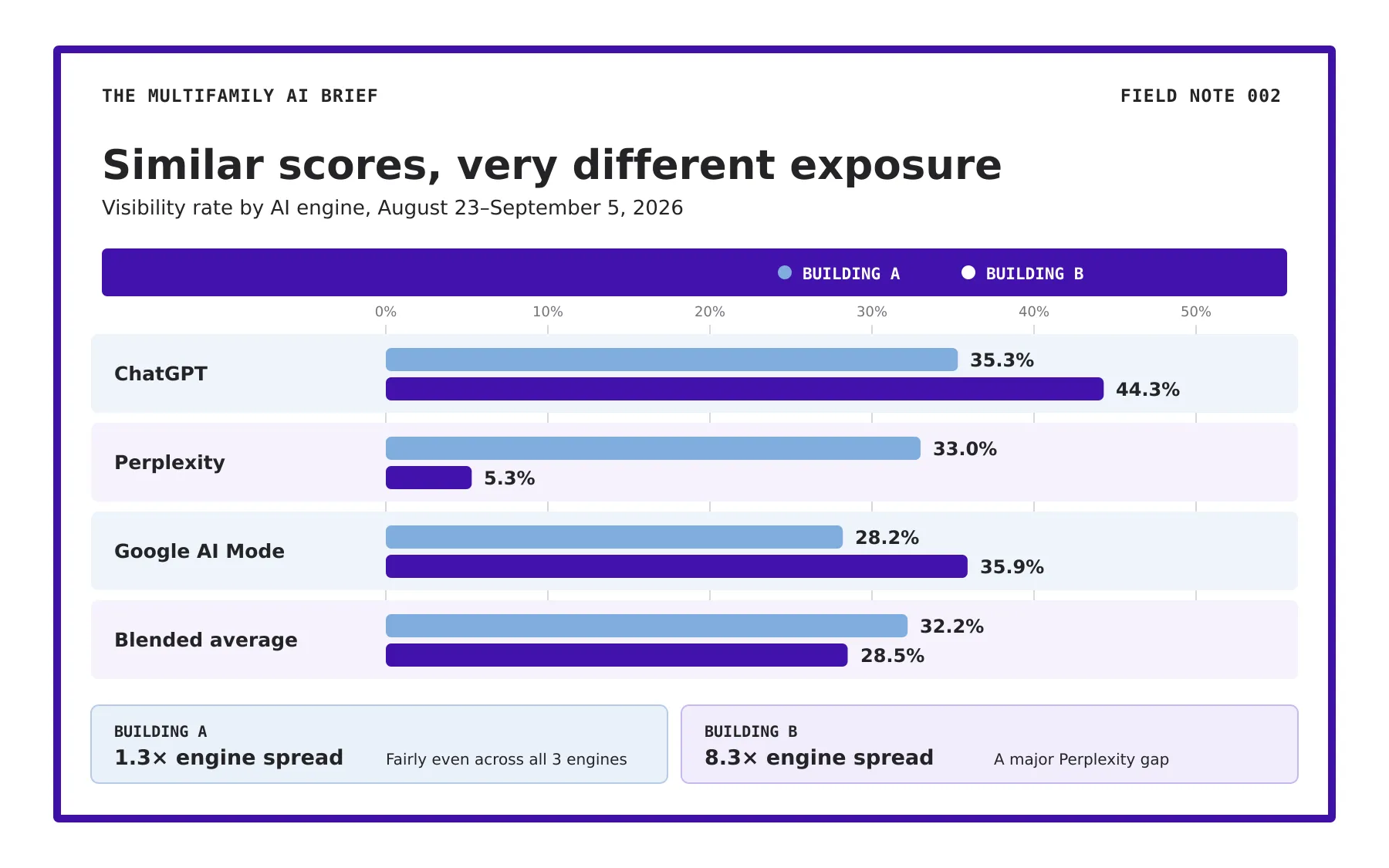
Building A appeared at a fairly consistent rate across all 3 AI engines.
Building B appeared more often in ChatGPT and Google AI Mode, but its Perplexity visibility fell to 5.3%.
The blended scores looked similar. The exposure behind them did not.
The average hid the important part
Multifamily marketers already deal with this in lead reporting.
Suppose a property generated 300 leads last month, but 200 came from 1 ILS Aggregator. The total sounds strong, but the source breakdown reveals how dependent that result is on 1 channel.
The same logic applies to AI visibility.
Building A’s highest engine visibility was 1.3 times its lowest. Building B’s was 8.3 times its lowest.
That does not mean Building B is performing poorly overall. It means its visibility is concentrated in 2 engines, something the blended score alone would never show.
The engines agreed, up to a point
This was not a case of ChatGPT, Perplexity, and Google AI Mode producing 3 completely unrelated apartment markets.
Nineteen buildings appeared across the 3 engines. When we compared how the engines ordered those buildings, all 3 relationships were positive.
The Spearman correlations were:
- 0.690 between ChatGPT and Perplexity
- 0.778 between ChatGPT and Google AI Mode
- 0.739 between Perplexity and Google AI Mode
Basically, the engines generally agreed about which buildings belonged near the top and which belonged near the bottom.
What they did not always agree on was how often an individual building should appear.
Among the 11 buildings with at least 10% blended visibility, the difference between the highest and lowest engine ranged from 1.3× to 8.3×.
That is the distinction a blended score misses.
What to look for in your reporting
An overall visibility score is still useful. It gives you a quick summary and makes it easier to track direction over time.
It just should not be the only number you see.
At minimum, look for:
- Visibility in each AI engine
- Your lowest-engine result
- The difference between your highest and lowest engine
- Whether that mix is changing over time
For a portfolio, review this community by community. One property may appear consistently across engines while another depends heavily on 1 or 2, even when their portfolio-level averages look nearly identical.
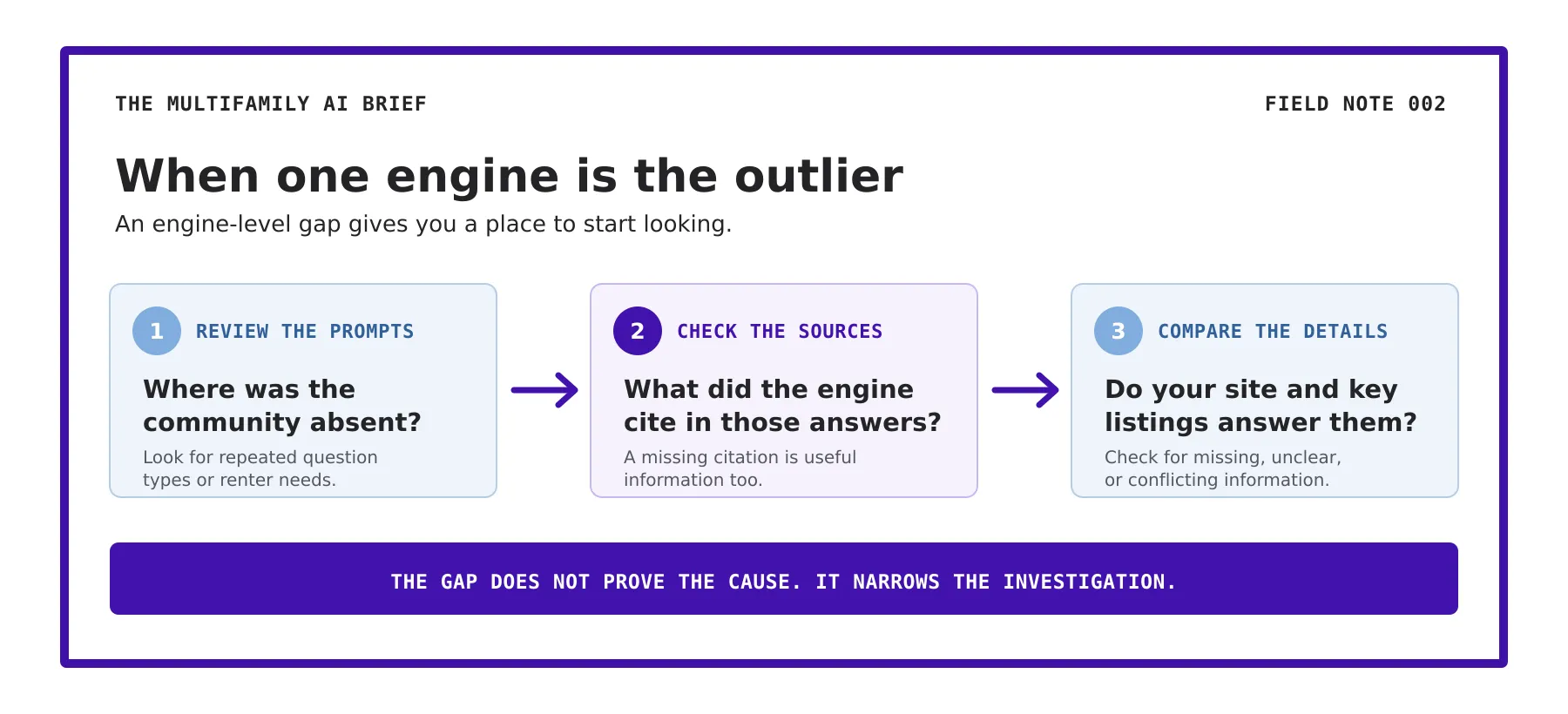
If a community’s visibility is concentrated, that is not automatically a problem. It is a signal to investigate the engine where the community appears least often.
Start with the prompts where the community was absent, the sources that engine cited, and whether the community website and major listings clearly answer those questions. The gap does not reveal the cause by itself, but it tells you where to start looking.
This is why keepfound reports both blended visibility and visibility by engine. The blended score gives you the summary. The engine breakdown shows what is happening underneath it.
Method: We collected 837 completed logged-out responses from August 23 through September 5, 2026, using scraper tools. The study used non-brand renter questions, 3 AI engines, a 14-day period, and 1 anonymized market. ChatGPT and Perplexity were geo-targeted to the state, while Google AI Mode was geo-targeted to the market. Visibility was the share of completed responses in which a building was named in the answer text. The prompt set expanded during the study, and Perplexity had incomplete coverage on several dates. Logging out rules out account history, but not every form of location or personalization.
About these observations: Findings reflect what we recorded on the dates stated. AI answers, search results, and property information change frequently, and results vary by engine, location, and over time. These observations do not establish a universal engine-agreement or concentration rate, evaluate any company’s performance, or endorse any product. Automated collection is closer to a controlled test than to a real renter’s experience. See our editorial standards and methodology.
The Multifamily AI Brief is research from keepfound, which is building a multifamily AI visibility platform to monitor renter-intent prompts, source attribution, competitor appearances, and the property information shaping AI answers.